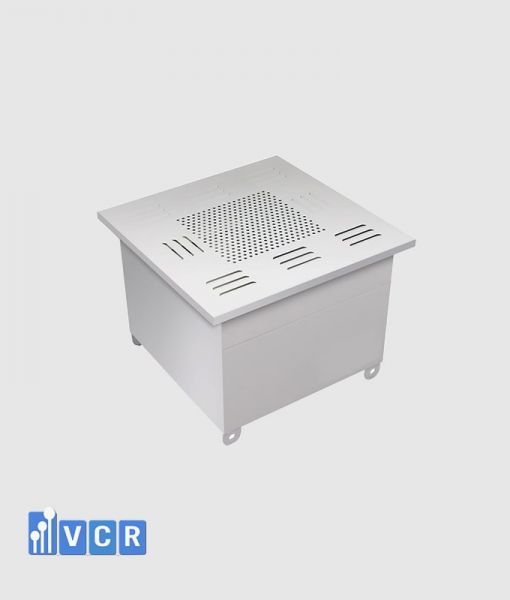
In real-world operation, “VCR Cleanroom Equipment” has found that many HEPA Box issues are not fully resolved because only symptoms are treated instead of identifying the root cause.
Why does a HEPA Box fail to deliver sufficient airflow and how can the root cause be identified step by step?
Insufficient airflow may result from clogged HEPA filters, improperly adjusted dampers, insufficient HVAC pressure, or duct leakage. Root cause identification requires a systematic approach: first check pressure differential across the filter, then measure airflow at the diffuser, inspect damper position, and evaluate upstream pressure from the AHU. If pressure differential is high while airflow is low, the filter is likely clogged; if both are low, the issue may originate from the HVAC system. Step-by-step diagnosis prevents misinterpretation and ensures accurate corrective action.
Why does a HEPA Box appear to operate normally while the cleanroom fails to meet cleanliness classification?
This situation often results from uneven airflow distribution, improper unit placement, or air leakage allowing unfiltered air into the cleanroom. Additionally, filter efficiency may degrade without obvious signs. Accurate diagnosis requires particle count measurements at multiple points, airflow verification, and DOP/PAO testing to confirm filter integrity. Identifying the true cause avoids unnecessary equipment replacement and ensures effective corrective measures.
Why does pressure differential across a HEPA Box increase abnormally and how should it be resolved?
An increase in pressure differential typically indicates filter clogging or airflow obstruction. Resolution involves inspecting and replacing the filter if necessary, as well as checking ductwork for blockages. Reviewing operating conditions helps prevent recurrence.
How should air leakage in a HEPA Box be handled to avoid system impact?
Air leakage is usually caused by degraded gaskets, improper installation, or insufficient filter clamping. Corrective action includes gasket replacement, resealing joints, and ensuring proper filter compression, followed by verification testing.
How should alarms from monitoring systems related to HEPA Boxes be handled?
Operators should review parameters such as pressure differential, airflow, and HVAC performance to identify the root cause and follow SOP-based corrective actions.
How can a HEPA Box be quickly checked without shutting down the system?
Quick checks can be performed using monitoring data, airflow measurements, and pressure readings to assess performance without interruption.
Is uneven airflow always caused by HEPA Box issues and how can it be distinguished?
Uneven airflow may result from HEPA Box issues or HVAC system imbalance, requiring comprehensive system evaluation.
What are clear signs of a clogged HEPA filter and how should it be addressed?
Increased pressure differential and reduced airflow indicate clogging, requiring filter replacement.
When should a HEPA filter be replaced immediately?
Immediate replacement is required when DOP/PAO tests fail or airflow drops significantly.
Does abnormal noise from a HEPA Box indicate a fault and what could cause it?
Yes, abnormal noise may result from excessive airflow or mechanical issues and should be investigated.
What should be checked first if a HEPA Box fails to meet airflow design?
Initial checks should include damper settings, filter condition, and HVAC system performance.
Can a HEPA Box cause pressure imbalance in the system?
Yes, unstable airflow or leakage can disrupt pressure balance between zones.
What should be done if DOP/PAO test results fail?
Inspect filters and seals and replace components as necessary to restore integrity.
How does airflow deviation from a HEPA Box affect cleanroom performance?
It can create dead zones and compromise cleanliness classification.
When should specialized technical support be called instead of self-troubleshooting?
When root causes cannot be identified or issues involve HVAC systems.
Can unresolved HEPA Box issues affect the entire system?
Yes, they can lead to environmental instability and system-wide failures.
Is it advisable to troubleshoot HEPA Boxes without checking HVAC systems?
No, as HEPA Boxes are part of an integrated system and root causes may lie upstream.
Should HEPA Box issues be recorded and analyzed?
Yes, documentation supports continuous improvement and audit readiness.
Are troubleshooting SOPs necessary and what are their benefits?
Yes, SOPs ensure consistent, fast, and accurate problem resolution.
How can an effective HEPA Box troubleshooting system be established to minimize downtime and optimize long-term performance?
An effective troubleshooting system requires structured root cause analysis starting from basic parameters such as airflow and pressure differential, followed by filter inspection, airtightness verification, and HVAC system evaluation. Personnel must be trained to recognize early warning signs and categorize issues by severity to apply appropriate corrective actions without unnecessary shutdowns. Recording and analyzing incident data over time helps identify recurring issues and improve system performance. A well-designed troubleshooting strategy ensures stable HEPA Box operation, minimizes downtime, and maintains ISO and GMP compliance throughout the system lifecycle.
Duong VCR